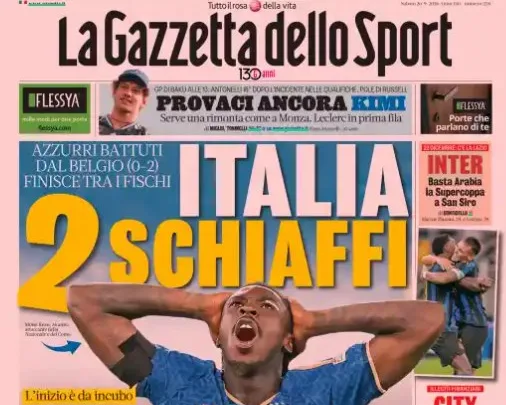
Italy have missed three World Cups in a row because they lost three play-offs: to Sweden in November 2017, to North Macedonia on 24 March 2022 and to Bosnia and Herzegovina on penalties on 31 March 2026. Each time they reached the play-offs after finishing second in their qualifying group. The way I see it, those were three versions of the same defeat. Italy did not have enough Italian players who start every week at the top level, they did not have a centre-forward they could trust, and each time the federation’s answer was a new coach instead of a new pathway for players.
What happened against Sweden in November 2017?
The road to the first failure started in Madrid. On 2 September 2017 Spain beat Gian Piero Ventura’s Italy 3-0, with Isco scoring twice, and that result decided qualifying Group G. Italy finished second and went into the play-offs.
The first leg was played at the Friends Arena in Solna on 10 November 2017. Sweden won 1-0. Jakob Johansson scored in the 57th minute, and his shot took a deflection off Daniele De Rossi on its way past Gianluigi Buffon.
Three days later, on 13 November 2017, Italy needed a goal at San Siro. The game finished 0-0. Sweden went through 1-0 on aggregate, and Italy missed a World Cup for the first time since 1958.
I keep coming back to the simplest number from that tie. Italy played 180 minutes against Sweden and did not score. A team that cannot score in three hours of play-off football has a problem that goes deeper than one bad evening.
How did the European champions lose to North Macedonia?
This is the one that still confuses people, and I understand why. Roberto Mancini was appointed on 14 May 2018. On 11 July 2021 his Italy beat England on penalties at Wembley to win Euro 2020. Eight months later they were out of the World Cup again.
The warning signs came in the autumn of 2021. Italy dropped points against Bulgaria and Switzerland in Group C, then drew 0-0 away to Northern Ireland on the final night while Switzerland beat Bulgaria 4-0. The Swiss went to Qatar. Italy went to the play-offs.
The semi-final was at the Stadio Renzo Barbera in Palermo on 24 March 2022. Ciro Immobile started up front. Italy had most of the ball and most of the chances, and the chances kept going begging. In the 92nd minute Aleksandar Trajkovski scored, and North Macedonia won 0-1.
For me, the Euro 2020 win covered a gap instead of closing it. That team won a tournament on collective strength, on the way everyone pressed, passed and defended together. Over a short qualifying run that needed goals, the gap up front came back.
How did Italy end up in a third play-off in 2026?
The 2026 qualifying draw put Italy in Group I with Norway and Erling Haaland. That group was always going to be decided by the two games between them, and Italy lost both.
On 6 June 2025 Norway beat Luciano Spalletti’s Italy 3-0 in Oslo. Two days later, on 8 June, Spalletti said he had been relieved of his duties. On 15 June the FIGC named Gennaro Gattuso as the new coach.
Gattuso won every other group game he took charge of, but the return match at San Siro on 16 November 2025 ended Norway 4, Italy 1. Francesco Pio Esposito put Italy ahead early, then Norway scored four in the second half, two of them from Haaland. Norway finished the group with a perfect record and 24 points. Italy finished second with 18. Haaland scored 16 goals in the campaign.
The play-off semi-final went to plan. On 26 March 2026 Italy beat Northern Ireland 2-0 in Bergamo, with goals from Sandro Tonali and Moise Kean. The final was in Zenica on 31 March 2026. Kean scored after 15 minutes. Alessandro Bastoni was sent off for a last-man foul in the 42nd minute. Bosnia and Herzegovina equalised through Tabaković in the 80th minute, and after 1-1 over 120 minutes they won the shootout. Pio Esposito and Bryan Cristante missed for Italy.
The fallout was fast. Gattuso resigned on 3 April 2026, and FIGC president Gabriele Gravina resigned too. Giovanni Malagò now runs the federation, and on 28 July 2026 he brought Mancini back.
What do the three nights have in common?
Put the three deciding nights side by side and one pattern jumps out. Against Sweden Italy scored nothing in 180 minutes. Against North Macedonia they scored nothing in 90. In Zenica they scored once in 120. That adds up to one goal in six and a half hours of the most important football Italy played in nine years.
Bad luck explains a deflection or a missed penalty. It does not explain a run that long. For me, the root is the pool of players.
The clearest recent picture I have seen came from Sky Sport Italia, which counted the minutes each club gave to Italian players in Serie A 2025/26 up to 22 April 2026. Only three clubs gave Italians more than half of their minutes: Cagliari, Cremonese and Fiorentina. Cagliari led with 64.2%. Como, at the other end, had given an Italian player just 14 minutes by that point. Corriere dello Sport, working from a separate dataset in March 2026, also put Cagliari top and singled out Como’s figure.
Look at which clubs top that list. The top five in the Sky Sport count were Cagliari, Cremonese, Fiorentina, Pisa and Lazio. The clubs that usually carry Italy in the Champions League are missing from it. That matters, because a national team that needs to win one-off nights needs players who are used to big games every week.
The centre-forward problem sits inside that bigger one. A striker learns to score in big games by playing big games. In my view Italy have spent nine years moving from one striker in form to the next, and none of them has held the shirt long enough to become the answer.
Why has changing the coach never fixed it?
Count the changes. Ventura went after Sweden. Mancini came in on 14 May 2018, then left in August 2023. Spalletti followed and was gone in June 2025. Gattuso lasted until April 2026. Now Mancini is back. That is five appointments, four of them since the Sweden tie, and three World Cups missed.
Every new coach inherited the same pool. A coach can change the system, the mood and the selection. He cannot create a centre-forward who plays in the Champions League every week, and he cannot make a Serie A club give minutes to a 20-year-old Italian over an experienced import.
That is the real lesson of the last nine years, as I read it. Italy kept treating a supply problem as a leadership problem.
What does Mancini’s second spell need?
Mancini’s first squad is where the second spell starts, and I have my doubts about it. The FIGC announced 34 players on 18 September 2026, and nine of them are uncapped. Among the new faces are Daniele Ghilardi of Roma, Antonio Vergara of Napoli, Alessandro Romano of Cagliari and Sebastiano Esposito of Sassuolo. Twenty-five of the 34 play in Serie A. If you want the full picture, our club-by-club breakdown of Mancini’s first Italy squad shows exactly where they come from.
I think the second spell needs three things, and the first is a settled number nine. Mancini called five players who can lead the line: Francesco Pio Esposito, Moise Kean, Gianluca Scamacca, Giacomo Raspadori and Daniel Maldini. My view is simple. He should pick one as the main option, and for me that is Pio Esposito or Scamacca, in either order. Kean in form enters the equation, but the long-term answer is one of those two. Give that striker a long run through the 2026/27 Nations League, including the games he does not score in. A striker who knows he will start in March plays differently in November.
The second is to pick on form and fitness. A wide squad of 34 looks like a show of trust in the Italian player, and to me part of it reads as popularity and PR. Nicolò Zaniolo, in my view short of full fitness and with unstable form, is the clearest example. Call-ups should reward young Italians who play every week. The players already featured on our list of Serie A’s best young players are the natural next wave, and the national team should be where their progress is rewarded.
The third is a vision, and that is what I am still waiting to see from Mancini. His first spell showed what continuity can build. It also showed that one trophy can hide a thin pool. This time the measure of success should be how many Italians start regularly for top-half Serie A clubs by the 2030 qualifiers, alongside the results.
The second spell opened with a busy Nations League window: Italy v Belgium at the Stadio Olimpico in Rome on 25 September 2026, one of the grounds in our guide to Italy’s biggest stadiums, then Türkiye in Bursa on 28 September, France at the Stade de France on 2 October and Türkiye again in Bologna on 5 October, while the Serie A season paused until 10 October 2026. Results in one window will come and go. The three things above are the measure I will use.
So why do Italy keep missing the World Cup?
Italy did not lose three World Cups on three bad nights. They lost them over nine years in which too few Italians played at the highest level and no centre-forward was given time to become the answer. Mancini has the chance to fix the thing that four coaching changes left untouched. If he builds a pathway instead of just a team, Italy will not need a fourth play-off to find out whether it worked.