TL;DR
- Calciopoli was the 2006 scandal in which wiretaps caught club executives, led by Juventus general manager Luciano Moggi, working the officials who picked Serie A referees. Juventus were relegated and lost two titles, while Milan, Fiorentina, Lazio and Reggina were docked points.
- The courts proved a system of influence but never a single altered result, and the criminal case against Moggi ended time-barred in March 2015.
- My read: Juventus earned their punishment, but handing the 2006 Scudetto to Inter was the mistake that keeps the argument alive twenty years later.
Calciopoli was a referee-influence scandal built on phone taps from the 2004/05 season and made public in May 2006, weeks before the World Cup. Executives from Juventus, Milan, Fiorentina and Lazio, along with senior FIGC figures, were recorded pressing the referee designators over who would officiate their matches. Juventus went down to Serie B for the first time in their history, and the fallout reshaped Serie A for a decade. Twenty years on, it is still the one subject that can turn any Italian football conversation into a fight.
Where does the name Calciopoli come from?
It is “calcio” plus “-poli”, borrowed straight from Tangentopoli, “Bribesville”, the early-1990s investigation that brought down a generation of Italian politicians. The press reached for the suffix because the pattern felt familiar. One phone call is a bad habit. Hundreds of them, running through the people who control the referees, is a system.
How did the wiretaps expose it?
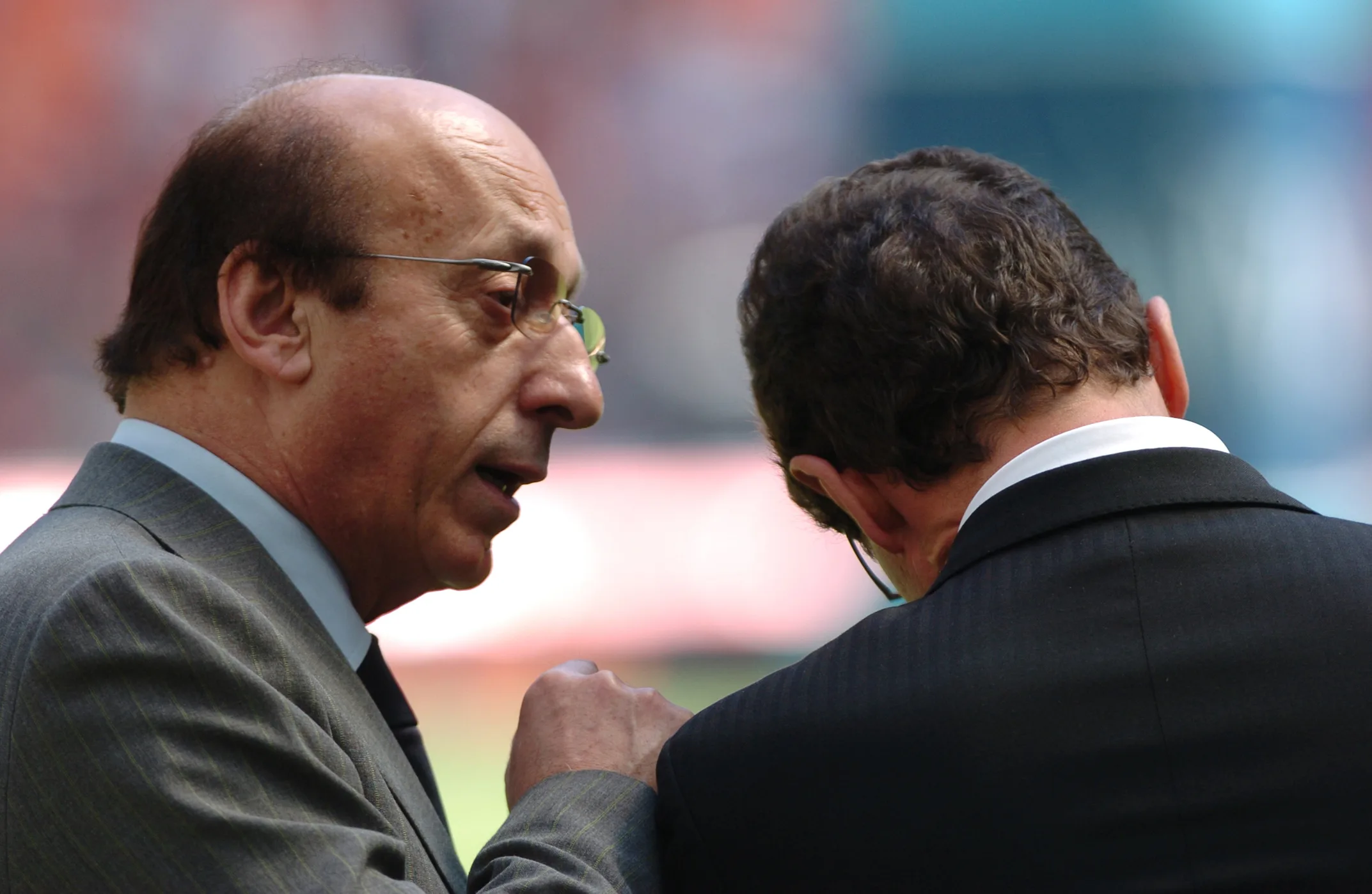
Prosecutors in Naples were listening, and what they heard centred on Moggi. He was on tape with the two referee designators, Pierluigi Pairetto and Paolo Bergamo, talking about which referees should get which games. He pushed for officials he trusted and against the ones he saw as hostile. Reading the transcripts today, it feels less like fixing a scoreline and more like arranging the room before anyone walks in. The calls showed an influence over appointments that no club executive should ever have had.
Later, investigators found Moggi had used foreign SIM cards bought in Chiasso, Switzerland, two of them for calls with Bergamo and Pairetto. Nobody buys Swiss SIM cards to chat about the weather.
Then there is the story everyone remembers. After Juventus lost away at Reggina in November 2004, Moggi allegedly locked referee Gianluca Paparesta in his dressing room. Moggi has always denied it. True or not, the fact that the whole country found it believable tells you everything about the climate referees worked in.
Moggi was the loudest voice on the tapes, far from the only one. Leonardo Meani, Milan’s referee liaison, asked for specific assistant referees for Milan matches. The Della Valle brothers at Fiorentina, who had complained publicly about refereeing, ended up using the same channels to escape relegation. Lazio president Claudio Lotito asked for protection from officials he considered unfriendly. And Innocenzo Mazzini, vice-president of the FIGC itself, acted as a go-between for clubs close to Moggi’s network.
Who was involved, and how deep did it go?
Why was Juventus at the centre of it?
Because Moggi and chief executive Antonio Giraudo ran something far bigger than the odd phone call. The Italian press called it the “Sistema Moggi”, a web of relationships with designators, federation officials and referees that tilted the ground towards Juventus. The other clubs knocked on the door. Juventus had the keys.
What did Milan, Fiorentina and Lazio do?
Milan’s role was smaller but real. Meani’s requests went through the same designators, and critics accused Adriano Galliani, then Milan’s vice-president and president of the Lega Serie A, of knowing about those contacts and letting them run. Fiorentina and Lazio went looking for favourable treatment through Moggi’s channels when their seasons were on the line.
What happened to the referees?
Massimo De Santis was due to be Italy’s referee at the 2006 World Cup. The FIGC pulled him from the tournament and he was handed a long ban. Pairetto and Bergamo were out. Paparesta was suspended for failing to report the pressure he was under, and others, such as Domenico Messina, were cleared. The picture was mixed, which is part of why the arguments never stopped.
What were the punishments?
The sports court ruled on 14 July 2006, the appeal came on 25 July, and CONI arbitration cut several penalties that autumn. Juventus took the heaviest blow by far. They were relegated to Serie B for 2006/07 and started on minus 9 points, the 2004/05 Scudetto was revoked, and the 2005/06 title went to Inter.
Fiorentina stayed in Serie A on appeal but started 2006/07 on minus 15 and lost their Champions League place. Lazio were docked 3 points and thrown out of the UEFA Cup. Milan lost 30 points from the 2005/06 table, which dropped them into the Champions League qualifiers, and started the new season on minus 8. Reggina were docked 11 points, and Arezzo 6 points in Serie B.
For the individuals, Moggi and Giraudo received five-year bans that the FIGC turned into lifetime bans in June 2011. Mazzini got five years. Meani was banned for more than two years, Galliani for 5 months, Diego and Andrea Della Valle for 8 and 13 months, and Lotito for 4 months.
Two footnotes say a lot about Italian football. Milan started the next season in the qualifiers and finished it by winning the Champions League in Athens in May 2007. And Buffon, Del Piero, Nedvěd, Trezeguet and Camoranesi went down with Juventus and brought them straight back up under Didier Deschamps.
What did the criminal courts decide?
The criminal case ran on a different track. In Naples, on 8 November 2011, Moggi was sentenced to five years and four months for promoting a criminal association. The appeal court cut that to two years and four months in December 2013, with the sporting-fraud charges already time-barred. In March 2015, Italy’s Court of Cassation cancelled what was left because of the statute of limitations.
That leaves the strangest possible ending. Moggi was never fully cleared and never served a day in prison. The courts described a system built to influence refereeing, yet no court ever established that a specific result had been changed.
Was Inter involved in Calciopoli?
This is where the story turns. During the Naples trial in 2010, Moggi’s defence produced wiretaps that had never been used in 2006, including calls between Inter president Giacinto Facchetti and the referee designators. The tone was friendly, the kind of contact other clubs had been punished for. Facchetti had died in September 2006 and could never answer for them.
In July 2011, FIGC prosecutor Stefano Palazzi concluded that Inter’s conduct would have amounted to a breach of Article 6, the most serious charge in the code. It changed nothing, because the case was already time-barred. Juventus have since challenged the 2006 title at every level available to them, most recently before the Council of State, which rejected the appeal in August 2023. The title stays with Inter.
One more detail keeps the suspicion alive. Guido Rossi, the FIGC’s extraordinary commissioner who handed Inter that title in 2006, had sat on Inter’s board between 1995 and 1999.
Why do Italians still disagree about it?
Because both camps are holding half the truth. A Demos poll from September 2011 found that 38.9% of fans saw Calciopoli as sports justice with serious errors, and 32.9% as an attempt to damage certain teams. Only 26.5% thought the decisions were correct. Asked about the 2005/06 Scudetto, 48.9% said it should go to nobody.
Many Juventus fans, and a fair number of journalists, see a political operation that weakened the club and cleared the road for Inter. Everyone else sees a club that bent the league and paid for it. I think the wiretaps on Moggi are damning and the punishment was earned. I also think the second set of calls should have been heard in 2006, and that the 2005/06 title should have stayed unassigned, exactly like 2004/05. Justice that depends on which tapes get played first is going to be argued about forever.
What did Calciopoli cost Italian football?
The talent went first. Cannavaro and Emerson left Juventus for Real Madrid, Thuram and Zambrotta for Barcelona, while Ibrahimović and Vieira moved to Inter. The league’s image took a hit with sponsors and broadcasters that took years to repair.
Italian clubs still won in Europe, with Milan in 2007 and Inter’s treble in 2010. The slide showed up in the coefficient instead. In 2011 the Bundesliga overtook Serie A in UEFA’s rankings and took Italy’s fourth Champions League place from 2012/13. The designator system that Moggi had worked so well was rebuilt from the top, and Juventus, Fiorentina and Lazio spent years rebuilding too.
Was Calciopoli a necessary purge or a political move?
It was a real purge carried out selectively. Italian football needed the shock, because the tapes showed a league where access to the referee designators counted for something. What it did not get was a process that treated every club the same way, and that gap is why the word still comes up every time a big decision goes against a big club.
Calciopoli proved how easily Italian football could be bent. The way it was handled proved that justice could be bent too. The league paid for both.
Last updated: September 2026