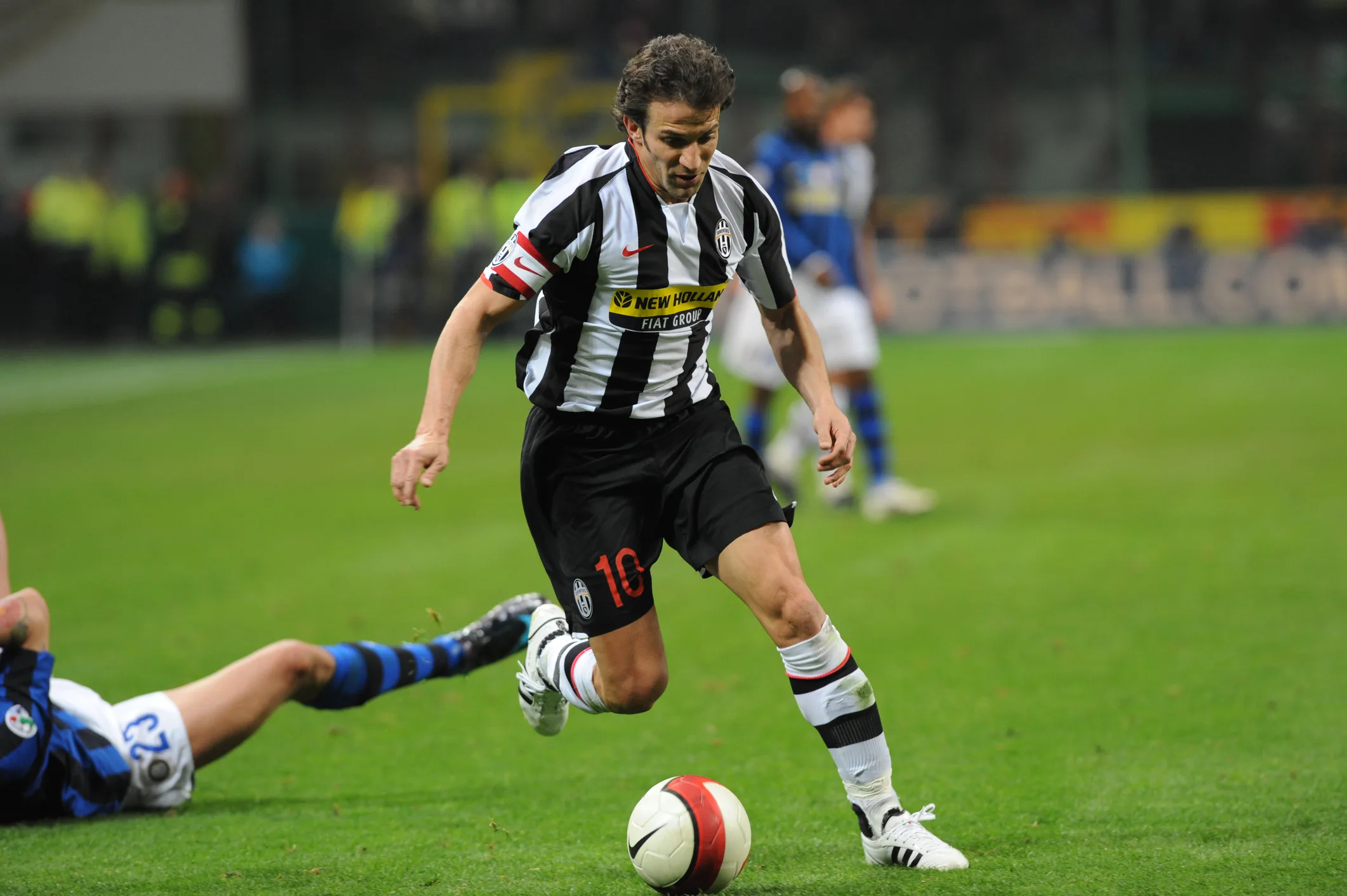
The Early Days: Joining Juventus
Del Piero arrived at Juventus in 1993 as a promising youngster from Padova. He made an immediate impact with his skillful touch, vision, and natural goal-scoring instinct. As a teenager, he quickly earned admiration from teammates and fans alike. However, few could predict how decisively he would shape the club’s future.
Pushing Baggio Aside and Conquering Europe
In those early years, Juventus already had a superstar: Roberto Baggio, the reigning Ballon d’Or winner. Del Piero’s emergence created a selection dilemma, but his performances left little room for debate. By 1995, he had effectively displaced Baggio, signaling the dawn of a new era. With Marcello Lippi on the bench, Del Piero became central to the team’s success.
Between 1994 and 1996, Juventus dominated Italian football, winning Serie A, Coppa Italia, and the 1996 UEFA Champions League. Del Piero’s creativity and composure in front of goal were crucial. His signature goals, curling shots into the top corner, became a trademark. In Europe, he stood out, scoring 42 goals in 89 Champions League appearances for Juventus, including decisive strikes against Real Madrid and Monaco.
The Best Team in the World (1995–1998)
During this period, Juventus were widely regarded as the best team globally. With a core of champions, Peruzzi, Deschamps, Vialli, and Zidane, Del Piero served as the creative spark and goal threat. He thrived under Lippi’s leadership, delivering consistent performances that earned him praise as the most talented Italian attacker of his generation.
Domestically, Juventus clinched titles, and in Europe, they reached three consecutive Champions League finals (1996, 1997, and 1998). Although they lifted the trophy only in 1996, their dominance was clear. Del Piero’s scoring record included 188 Serie A goals in 478 matches and 290 goals in all competitions, confirming his place among Juventus legends.
International Disappointments and a Captain’s Responsibility
While Del Piero excelled for Juventus, his early international career was less rewarding. He played in Euro 1996 and the 1998 World Cup but struggled to replicate his club form. After Italy’s elimination in France 98, Del Piero was deeply criticized for underwhelming performances.
In a remarkable gesture during one match, goalkeeper Angelo Peruzzi handed Del Piero the captain’s armband mid-game, saying, “We want you to lead us.” It was an attempt to restore his confidence after the turbulent national team experiences. This moment marked the beginning of Del Piero’s long captaincy at Juventus.
The Leg Break and Juventus Collapse
On a cold November evening in 1998, disaster struck. During a league match in Udine that ended 2–2, Del Piero suffered a serious leg fracture. Without their talisman, Juventus imploded, finishing seventh, a shocking result for such a dominant team. Marcello Lippi resigned in February 1999. Years later, Lippi admitted: “With Ale fit, we would have won that year.”
The Struggle to Return
Del Piero fought hard to regain his form. The 1999–2000 season saw a painful struggle. He scored just one goal from open play, with the rest coming from penalties. Juventus again fell short, losing the Serie A title on the last matchday. Despite his efforts, the magic seemed lost.
Euro 2000: The Misses That Haunted Him
Hoping to redeem himself on the international stage, Del Piero joined Italy for Euro 2000. But in the final against France, he missed two critical chances that could have secured the title. When Italy conceded the golden goal, Del Piero became the scapegoat. The media and fans subjected him to months of intense criticism, which took a heavy toll on his confidence.
Falling Down the Pecking Order
Back at Juventus, Del Piero was no longer an automatic starter. Filippo Inzaghi and later David Trezeguet were preferred in the attack. His form fluctuated, and whispers circulated that he might never reach his old heights again. Off the pitch, he was dealing with immense personal loss, his father passed away from cancer in 2001, a tragedy that affected him deeply.
The Resurgence
Despite these struggles, Del Piero rediscovered his scoring touch. He ended the 2000–01 season by helping Juventus finish second, showing glimpses of his past brilliance. When paired with Trezeguet, he regained his confidence and rhythm in front of goal.
The following seasons saw a revival. Under Lippi, Del Piero guided Juventus to consecutive Serie A titles in 2002 and 2003 and a Champions League final in 2003 against AC Milan, which ended 0–0 and was decided by penalties. Although they lost, Del Piero’s leadership was unquestioned.
The Capello Era and Calciopoli
When Fabio Capello took over, Del Piero faced new competition from Zlatan Ibrahimović. He often started from the bench but continued to score vital goals. In 2006, everything changed. The Calciopoli scandal erupted, and Juventus were stripped of two Serie A titles and relegated to Serie B.
In that moment of crisis, Del Piero’s loyalty became legendary. He chose to stay and declared: “A true gentleman will never leave his old lady.” Along with Buffon, Camoranesi, Chiellini, and Trezeguet, he led the club back to Serie A at the first attempt.
World Cup Glory
Remarkably, just weeks before Juventus’s demotion, Del Piero enjoyed the greatest night of his international career. At the 2006 World Cup in Germany, he scored against the hosts in the semi-final and converted his penalty in the shootout final against France. Italy lifted the World Cup, giving Del Piero long-awaited redemption on the global stage.
Return to Serie A and Top Scorer Title
In the 2007–08 season, Juventus finished third in Serie A, and Del Piero achieved another milestone, becoming Serie A’s top scorer with 21 goals at age 33. It was an extraordinary personal triumph, silencing any remaining doubts about his abilities.
Final International Appearances
Euro 2008 marked his final appearance for Italy. Though no longer a starter, he remained a respected figure in the squad. Italy were eliminated by Spain in the quarter-finals on penalties, bringing an end to Del Piero’s national team journey.
The Decline and One Last Scudetto
The following seasons were difficult. Poor managerial choices and bad investments, including players like Diego, Amauri, and Felipe Melo, left Juventus struggling. Ciro Ferrara, Alberto Zaccheroni, and Luigi Del Neri all failed to restore the club to glory. Del Piero accepted a massive pay cut to stay for one last season.
Under Antonio Conte in 2011–12, Del Piero played mainly as a substitute. But he still contributed decisive goals and lifted the Scudetto one final time. After 19 years, Juventus decided not to renew his contract. His departure was marked by tears, gratitude, and a sense of unfinished business, as he never returned in any official role with the club.
Legacy of a Legend
Alessandro Del Piero’s legacy is undeniable. He remains Juventus’s all-time top scorer with 290 goals and the symbol of loyalty in an era of fleeting allegiances. His technical elegance, leadership, and love for the Bianconeri have secured his place among the greatest footballers of all time.
From displacing Baggio to winning the Champions League, enduring injuries, enduring criticism, and leading Juventus through its darkest hour, Del Piero’s story is a testament to resilience and class. He will forever be remembered as Juventus’s eternal number ten.