| Full name | Andriy Mykolayovych Shevchenko |
|---|---|
| Milan years | 1999-2006, loan 2008-09 |
| Milan goals | 175, second in club history |
| Honours at Milan | Champions League 2003, Serie A 2004, Coppa Italia 2003, UEFA Super Cup 2003 |
| Capocannoniere | 1999-2000 and 2003-04, 24 goals each time |
| Individual | Ballon d’Or 2004 |
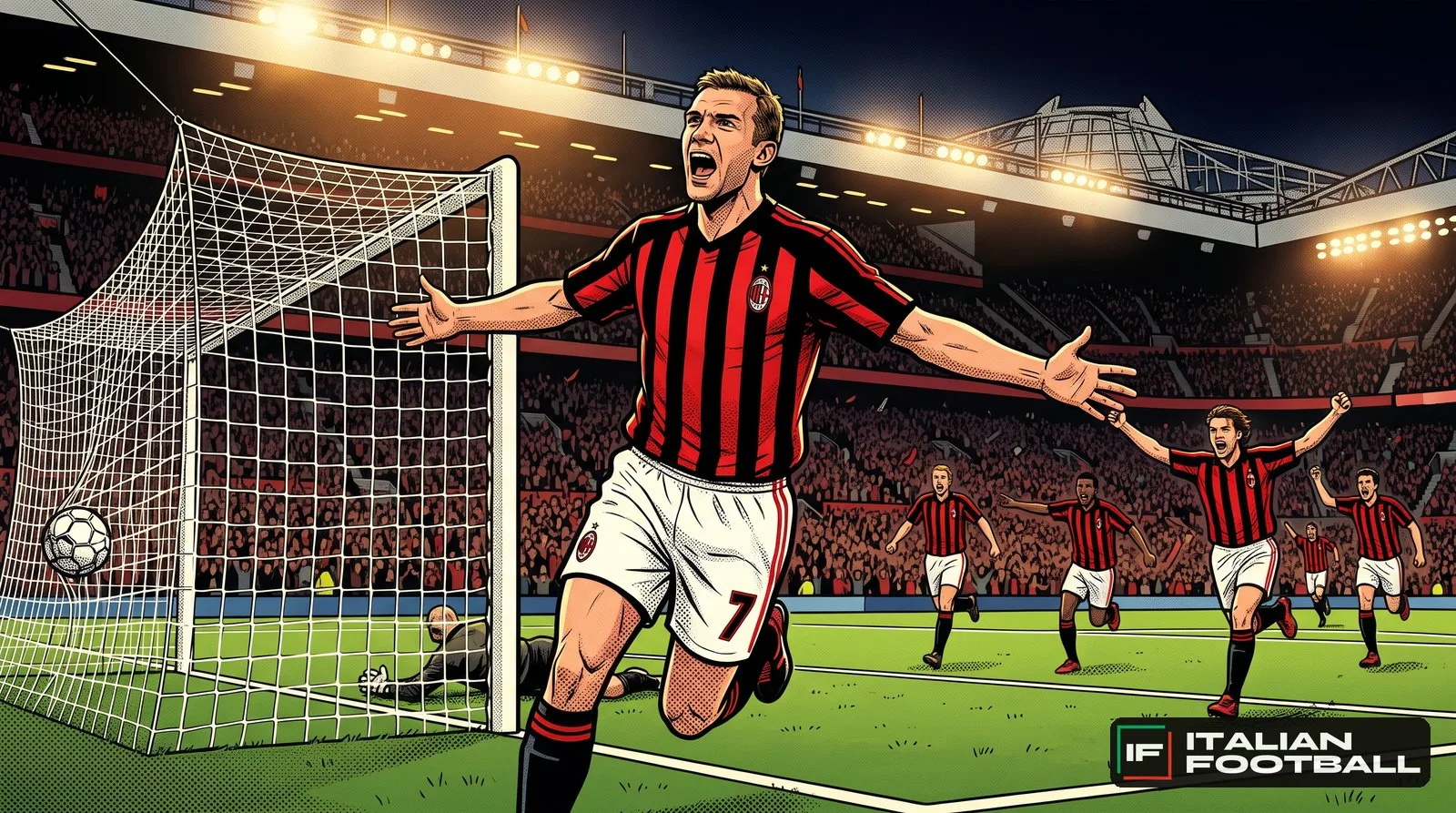
Old Trafford, 28 May 2003. Two Italian giants have played 120 minutes without a goal, and the first all-Italian Champions League final comes down to a single kick. Andriy Shevchenko places the ball, takes a few steps back, glances at Gianluigi Buffon and waits. A short run, a calm finish into the corner, and Milan are champions of Europe. Shevchenko turns, arms wide, and the Milan end of Old Trafford loses its mind.
That moment was the peak of a seven-year love affair between Milan and a striker from Kyiv who arrived as a promising foreign import and left as the best player in the world.
How did Shevchenko end up at Milan?
Shevchenko grew up at Dynamo Kyiv under Valeriy Lobanovsky, a coach whose scientific methods produced athletes as much as footballers. In 1998-99, Dynamo reached the Champions League semi-finals, and Shevchenko terrorised defences across Europe, including a hat-trick away at Barcelona the season before. Milan had just won the Scudetto under Alberto Zaccheroni and moved quickly to sign him in the summer of 1999.
Doubters wondered how a player from the Ukrainian league would adapt to Italian defending. He answered with goals from the very first month.
How good was Shevchenko’s first season in Serie A?
Exceptional. Shevchenko scored 24 league goals in 1999-2000 and won the Capocannoniere at his first attempt, a feat that very few foreign strikers have managed in Italy. He combined everything Serie A demanded: pace to run in behind, power to finish from distance, intelligence to lose his marker in the box, and the work rate Lobanovsky had drilled into him. Milan did not win the league that year, but they had found the striker who would define their next era.
His early seasons came at a time when Milan were rebuilding after the Capello and Sacchi glory years, the era we revisit in our story on Milan’s 4-0 win over Barcelona in 1994. Shevchenko became the bridge to the Ancelotti years.
What made Ancelotti’s Milan with Shevchenko so special?
Carlo Ancelotti arrived in late 2001 and built one of the most elegant teams of the century. Andrea Pirlo moved into a deep playmaking role, Clarence Seedorf and Gennaro Gattuso flanked him, Rui Costa and later Kaká played behind the strikers, and Shevchenko and Filippo Inzaghi shared the goals. At the back stood Paolo Maldini and Alessandro Nesta, the finest defensive pairing in Europe.
Shevchenko was the finisher who turned all that possession into trophies. In 2002-03 Milan won the Coppa Italia and the Champions League, beating Inter in a semi-final where Shevchenko’s goal in the second leg, with Inter as the home side at San Siro, proved decisive on away goals, before the shootout win over Juventus in Manchester.
Why did Shevchenko win the Ballon d’Or in 2004?
Because 2003-04 was his masterpiece. Shevchenko scored 24 Serie A goals, won his second Capocannoniere and led Milan to the Scudetto with a team many fans consider the best Milan side since the early 1990s. He scored in the UEFA Super Cup win over Porto too. That December he was named Ballon d’Or winner, the first Ukrainian since Igor Belanov in 1986, and he dedicated the award to his country.
Why is Shevchenko a Milan derby legend?
Few things make a Milan fan smile like the name Shevchenko on derby day. He scored 14 goals against Inter, more than anyone in the history of the Derby della Madonnina. Some were thunderbolts, some were tap-ins, all of them were celebrated as if they were winning a final. For a generation of rossoneri, beating Inter and watching Shevchenko score were the same thing.
What happened in Istanbul in 2005?
This is the painful chapter. Milan led Liverpool 3-0 at half-time of the 2005 Champions League final and somehow conceded three goals in six minutes. In the last minutes of extra time, Shevchenko had a close-range chance and Jerzy Dudek made a double save that defied belief. Then, in the shootout, Shevchenko stepped up with Milan needing to score, and Dudek saved his penalty. The man who had won the 2003 final from the spot lost the 2005 final in the same way.
Milan would get revenge against Liverpool in Athens in 2007, but by then Shevchenko had left for Chelsea, where injuries and a different style meant he never reached the same heights. He returned to Milan on loan in 2008-09, older and slower, and the San Siro welcomed him like family.
What is Shevchenko’s legacy at Milan?
His 175 goals for the club rank second in Milan history, behind only Gunnar Nordahl. He won everything that mattered at club level, and he did it in a league that was still, in the early 2000s, packed with world-class defenders. He belongs on the list of the great foreign strikers of the era, alongside the men in our series on Serie A in the 90s and 2000s, and for Milan fans he sits close to the top of the best AC Milan players in history.
If Shevchenko was the modern athlete-striker, the era also had the opposite kind of hero, and the story of Dario Hübner, who won the scoring title at 35, shows how wide the range of great Serie A strikers really was.
Frequently asked questions
How many goals did Shevchenko score for Milan?
Andriy Shevchenko scored 175 goals for Milan, second only to Gunnar Nordahl in the club’s history.
When did Shevchenko win the Ballon d’Or?
Shevchenko won the Ballon d’Or in 2004 after scoring 24 Serie A goals and leading Milan to the Scudetto.
Who has scored the most goals in the Milan derby?
Andriy Shevchenko holds the record with 14 goals for Milan against Inter in the Derby della Madonnina.