| Era | Roughly 1989 to 2007 |
|---|---|
| The Seven Sisters | Juventus, Milan, Inter, Roma, Lazio, Fiorentina, Parma |
| Champions League finals with an Italian club | Seven straight, 1992 to 1998 |
| UEFA Cup wins by Italian clubs, 1989 to 1999 | Eight |
| All-Italian Champions League final | Milan v Juventus, Old Trafford, 2003 |
Close your eyes and you can still hear it. The theme music on a Sunday afternoon, the crackle of a stadium that sounded twice as loud as anywhere else, and a league table where the team in eighth place had a Ballon d’Or contender up front. For the best part of two decades, the best footballers on the planet wanted one thing: a shirt in Serie A. They got it, and we got the greatest league football has ever produced.
This is the home page of our golden era series. Every story below is a door back into that world, from the superstars who defined it to the provincial clubs that made it so deep, so tactical, and so wildly entertaining.
How dominant was Serie A in the 1990s?
Dominant enough that the numbers still look like a typing error. Between 1992 and 1998, an Italian club played in seven consecutive European Cup and Champions League finals. Sampdoria lost at Wembley in 1992, Milan reached three finals in a row from 1993 to 1995, and Juventus followed with three straight from 1996 to 1998. In the UEFA Cup, which in those years was arguably harder to win than the Champions League because Italy sent four or five elite sides into it, Italian clubs lifted the trophy eight times between 1989 and 1999. Some finals were all-Italian affairs, which tells you everything about where the power sat.
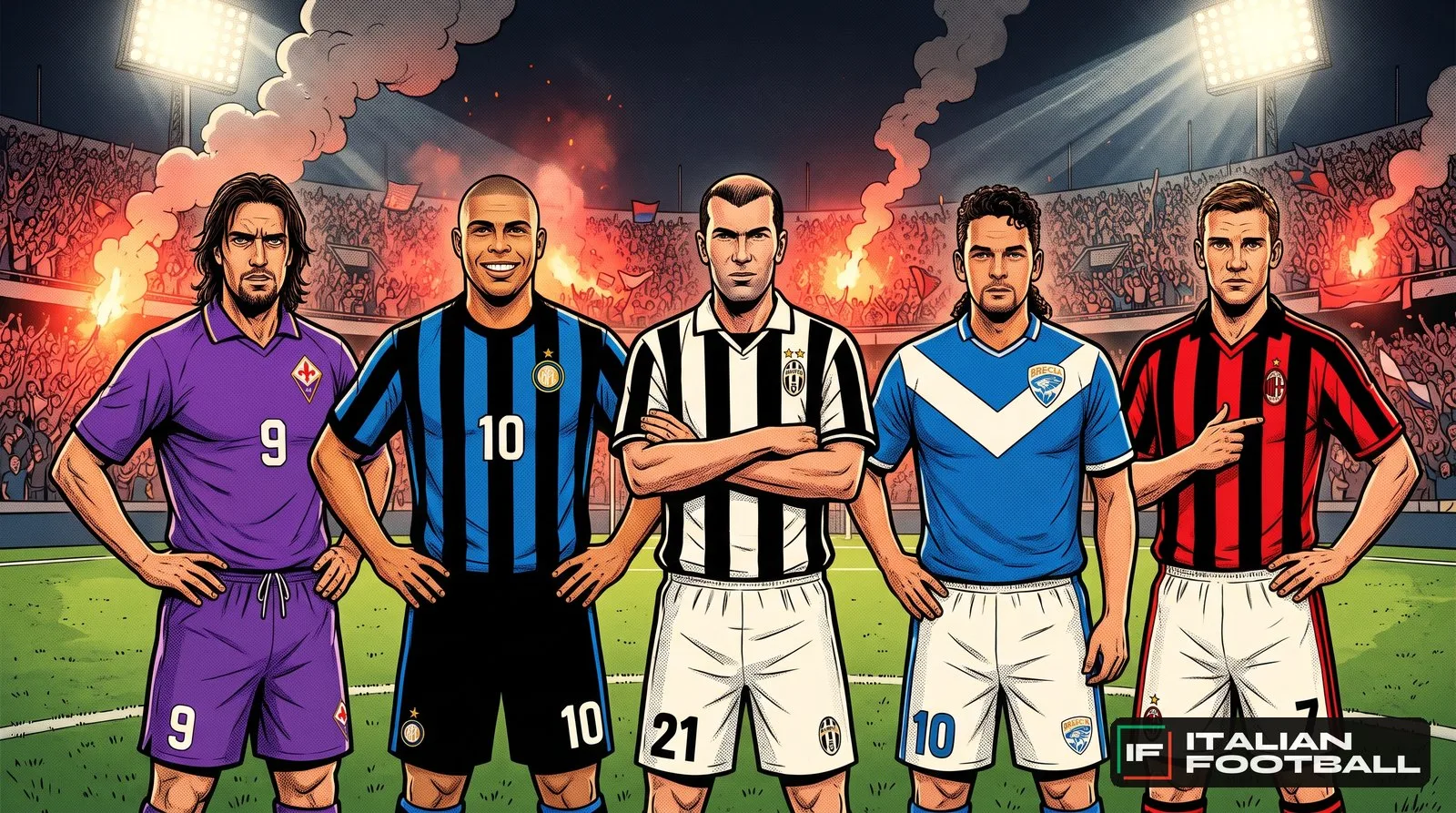
The individual awards told the same story. Of the ten Ballon d’Or winners from 1989 to 1998, seven were Serie A players when they won it: Marco van Basten twice, Lothar Matthäus, Roberto Baggio, George Weah, Ronaldo and Zinedine Zidane. If you wanted to be crowned the best in the world, you went to Italy to prove it.
Who were the Seven Sisters of Italian football?
The Seven Sisters were the clubs with the money, the stars and the ambition to win the Scudetto in any given season: Juventus, Milan, Inter, Roma, Lazio, Fiorentina and Parma. Think about that list for a moment. Seven genuine title contenders in one league, each with a squad that could reach a European final. No league before or since has had that kind of depth at the top.
Parma were the newcomers who gatecrashed the party, and the story of Parma in the 1990s, from Serie B to European royalty, is one of the most remarkable rises in the history of the sport. Lazio, bankrolled by Sergio Cragnotti, assembled a squad of stars and finally delivered the dramatic Lazio 2000 Scudetto on the last day of the season. Fiorentina had Gabriel Batistuta, Rui Costa and a passionate city behind them, before the fall of the Fiorentina of 1999, from the Champions League to bankruptcy, turned into the era’s cruellest cautionary tale.
Why did the world’s best players all go to Italy?
Money mattered, of course. Italian presidents, many of them industrialists who saw a football club as a national stage, paid wages no one else could match. Yet the deeper pull was prestige. Serie A was the hardest league in the world to score in, with defenders schooled in a tactical culture that treated a clean sheet as a work of art. A striker who scored 20 goals in Italy had nothing left to prove.
So they came. Ronaldo at Inter arrived as the most expensive player on earth and played like a man from the future. Zidane’s Juventus years turned a talented Frenchman into the best midfielder of his generation. Shevchenko at Milan won the scoring title in his first season, and Batistuta at Fiorentina became a living legend, complete with a statue built while he was still playing.
What made the tactics of that era so special?
Arrigo Sacchi’s Milan had rewritten the rules at the end of the 1980s with zonal pressing and a defensive line that squeezed the pitch into a tiny box. The coaches who followed took those ideas and argued about them every week, on the pitch and on television. Fabio Capello made Milan ruthless, and the night his side dismantled Johan Cruyff’s Dream Team remains one of the great performances in any final, which is why Milan 4-0 Barcelona, Athens 1994 gets its own chapter in this series.
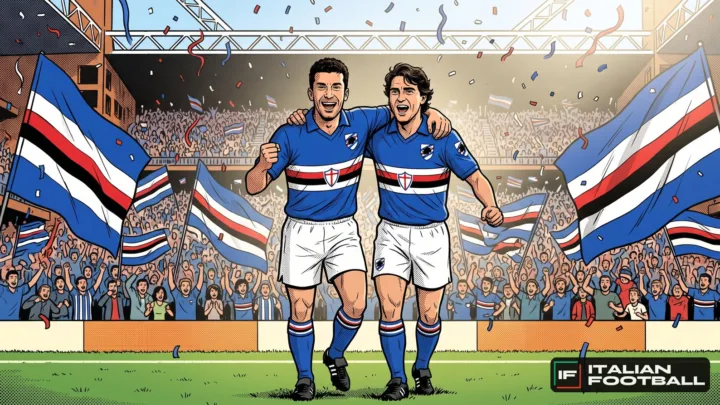
Further down the table, the experiments were even bolder. Alberto Zaccheroni built a fearless attacking machine in Friuli, and Zaccheroni’s Udinese and their 3-4-3 went from curiosity to model in barely a season. Earlier, Vujadin Boškov had turned a club from Genoa into champions, and the joy of Sampdoria in 1991 still makes grown men in blue, white, red and black emotional today.
Why were the provincial clubs just as unforgettable?
Because they had real players, and they had nothing to lose. A mid-table side in the 1990s often had an international striker, a World Cup defender and a playmaker who would walk into most teams in Europe today. That is how Vicenza won the Coppa Italia in 1997 and then reached a European semi-final. It is how Chievo in 2001-02, the flying donkeys, sat on top of Serie A in their first ever season in the top flight.
The provinces also gave us the scorers we still talk about with the biggest smiles. Igor Protti won the Capocannoniere with a relegated Bari, a feat no other player has matched. Dario Hübner topped the scoring chart for Piacenza at 35, with a cigarette habit that became part of the legend. Giuseppe Signori was crowned top scorer three times and was so loved that Lazio fans took to the streets to stop his sale.
Who were the cult heroes of the era?
Every great league needs its characters, and Serie A had a cast no screenwriter would dare invent. Álvaro Recoba, Inter’s left-footed genius, could score from anywhere and disappear for weeks at a time. Edmundo at Fiorentina left for the Rio carnival in the middle of a title race. Taribo West, with his braids and his faith, once told Marcello Lippi that God wanted him in the starting eleven.
Then came the players who brought new audiences to the league. Hidetoshi Nakata‘s journey from Perugia to Roma made Serie A essential viewing across Asia, while Gianfranco Zola at Napoli and Parma produced the magician English football would later adore. Pavel Nedvěd ran through walls for Lazio and Juventus and won the Ballon d’Or in 2003. And Roberto Baggio at Brescia and Bologna proved that the Divine Ponytail saved some of his best magic for the smaller stages.
When did the golden era end?
There is no single date, but the cracks appeared early in the new century. The financial empires behind Parma, Lazio and Fiorentina collapsed between 2002 and 2004, and the Calciopoli scandal of 2006 sent Juventus to Serie B and stripped the league of its shine. The Premier League’s television money did the rest, and the stars started heading to England and Spain instead.
Still, the era ended with a flourish. Milan and Juventus met in an all-Italian Champions League final at Old Trafford in 2003, Italy won the World Cup in 2006 with a squad built entirely in Serie A, and Milan lifted the Champions League again in 2007. The league went out on top.
Why does this era still matter to football fans?
Because it set the standard. Every conversation about the greatest team, the greatest defence or the greatest number 10 eventually travels back to Italy in those years. It was football at its most demanding and its most beautiful, and it was on our screens every single weekend. Pick a story from this series, and enjoy the trip back.
Frequently asked questions
Was Serie A the best league in the world in the 1990s?
Yes, by almost every measure. Italian clubs reached seven consecutive Champions League finals from 1992 to 1998, won eight UEFA Cups between 1989 and 1999, and seven of the ten Ballon d’Or winners from 1989 to 1998 played in Serie A.
What were the Seven Sisters in Italian football?
The Seven Sisters were the seven clubs that could realistically win the Scudetto in the 1990s and early 2000s: Juventus, Milan, Inter, Roma, Lazio, Fiorentina and Parma.
Why did Serie A decline after the 2000s?
The financial collapse of several club owners between 2002 and 2004, the 2006 Calciopoli scandal and the rapid growth of Premier League television revenue pushed the top players toward England and Spain.