| Full name | Gianfranco Zola |
|---|---|
| Born | Oliena, Sardinia, 1966 |
| Serie A clubs | Napoli 1989-93, Parma 1993-96, Cagliari 2004-05 |
| Honours in Italy | Serie A 1990, Supercoppa 1990 (Napoli); UEFA Super Cup 1993, UEFA Cup 1995 (Parma) |
| Mentor | Diego Maradona |
| Next stop | Chelsea, from November 1996 |
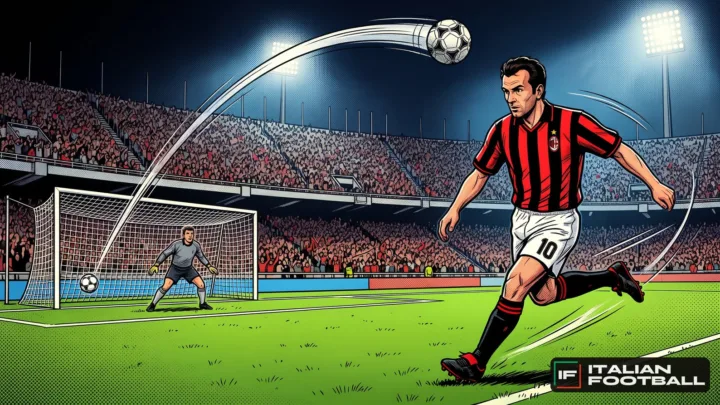
After training at Napoli, so the story goes, two small men would stay behind on the pitch. One of them was the greatest footballer in the world. The other was a quiet 23-year-old from a village in Sardinia, watching closely as Diego Maradona curled free kick after free kick over a wall and into the top corner. Then the young man would try it himself. Again and again, until the ball started to bend the same way.
That young man was Gianfranco Zola, and those sessions shaped one of the most elegant playmakers of the 1990s. English fans remember him as Chelsea’s magician. Before that, he lit up Serie A in its golden age.
How did Zola end up at Napoli?
Zola came from the lower divisions of Sardinian football, playing for Nuorese and Torres in Serie C. He was small, technically gifted and quick between the lines, and in 1989 Napoli signed him as a backup for Maradona. For a young player who had never played in Serie A, it was like being handed an apprenticeship with a genius.
He made the most of it. Zola trained with Maradona every day, learned from his movement and his set pieces, and stepped in whenever the Argentine was injured or suspended. In 1989-90, Napoli won their second Scudetto, and Zola contributed important goals in the title run. He has always said that Maradona taught him more than any coach.
What happened when Maradona left Napoli?
In 1991, Maradona left Italy, and Napoli handed the most famous shirt in the club’s history to Zola. Wearing the number 10 after Maradona was an impossible burden, but Zola carried it with grace. Over the next two seasons he became Napoli’s creative leader and earned his first call-ups to the Italian national team. Napoli, though, were in decline, financially and on the pitch, and in 1993 they sold him to the ambitious club from Emilia that was rewriting the order of Italian football.
What did Zola win at Parma?
Parma, owned by the Parmalat empire of Calisto Tanzi, had just won the Cup Winners’ Cup, and they were building a team to compete with the giants. Zola arrived in 1993 and joined a squad with Faustino Asprilla, Tomas Brolin, Antonio Benarrivo and Lorenzo Minotti. In his first season, Parma beat Milan in the UEFA Super Cup and reached the Cup Winners’ Cup final again, losing to Arsenal in Copenhagen.
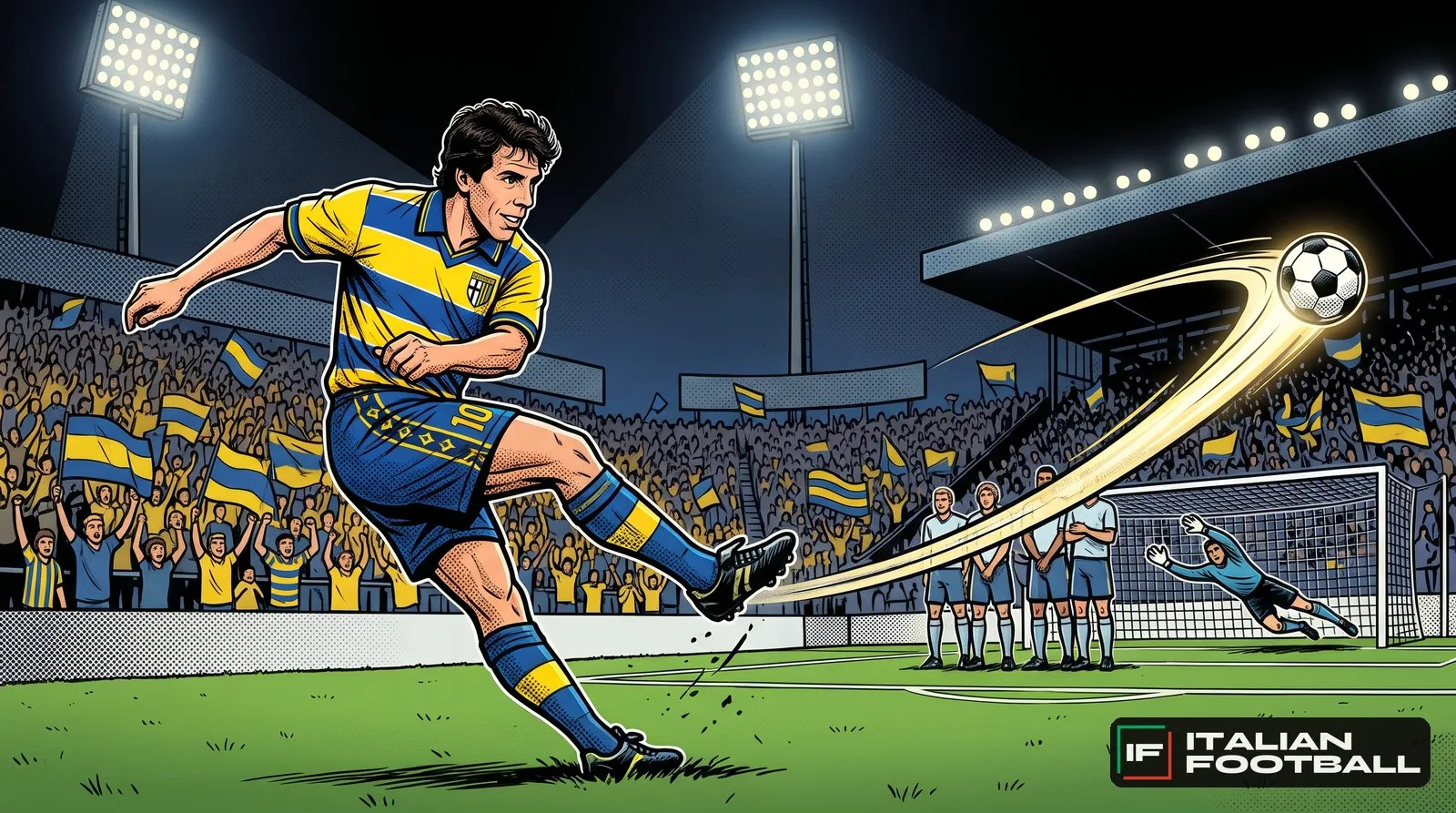
In 1994-95 came the high point. Parma won the UEFA Cup, beating Juventus over two legs in the final, and Zola was at his peak: dribbling past defenders in tight spaces, scoring spectacular free kicks and providing the passes that made Parma one of the most attractive teams in Europe. The full story of that remarkable club is in our piece on Parma’s golden decade.
Why did Zola leave Parma for Chelsea?
In 1996, Parma appointed a young coach named Carlo Ancelotti. At that stage of his career, Ancelotti was a disciple of Arrigo Sacchi’s rigid 4-4-2, a system with no room for a classic number 10. He signed Hernán Crespo, partnered him with Enrico Chiesa up front, and moved Zola to the left wing. Zola struggled in the role and his minutes dropped.
In November 1996, Chelsea, managed by Ruud Gullit, signed him. Ancelotti later admitted that letting Zola go was one of his biggest mistakes, and that his experience with Zola taught him to build systems around great players rather than forcing players into systems. Ironically, that lesson helped him create the flexible Milan side that would dominate Europe a few years later, featuring Andriy Shevchenko, Andrea Pirlo and Rui Costa.
What was Zola’s international career like?
Bittersweet. At the 1994 World Cup, in the round of 16 against Nigeria, Zola came on as a substitute and was sent off minutes later, on his 28th birthday, in a decision many still consider harsh. At Euro 96, he missed a penalty against Germany in a match Italy needed to win, and they went out in the group stage. He never quite became the star for Italy that he was for his clubs, partly because he played in the same era as Roberto Baggio, whose later career we cover in our story on Baggio at Bologna and Brescia.
Did Zola return to Serie A?
Yes, and the ending was perfect. After seven years at Chelsea, Zola went home to Sardinia in 2003 to play for Cagliari, then in Serie B. He helped them win promotion and played one final season in Serie A in 2004-05, before retiring at 38. He chose to finish where his story had begun, in front of his own people.
What is Zola’s legacy in Italian football?
Zola embodies the golden era’s love of the fantasista. He learned from the greatest of them all at Napoli, won a European trophy with Parma, and proved that a small, humble player from the provinces could reach the very top. His departure in 1996 also signalled a shift: a great Italian creative player in his prime chose England over Serie A, a hint of how the balance of power in Europe would change. That bigger story runs through our series on Serie A in the 90s.
For Napoli and Parma fans, he will always be the little magician who made the ball do whatever he wanted.
Frequently asked questions
Did Gianfranco Zola play with Maradona?
Yes. Zola joined Napoli in 1989 as Maradona’s understudy, trained with him every day and won the 1990 Scudetto alongside him.
What did Zola win with Parma?
Zola won the UEFA Super Cup in 1993 and the UEFA Cup in 1995 with Parma, and reached the 1994 Cup Winners’ Cup final.
Why did Zola leave Parma?
New coach Carlo Ancelotti played a rigid 4-4-2 and moved Zola to the left wing in 1996. Zola lost his central role and joined Chelsea in November 1996.