| Season | 2001-02, Chievo’s first in Serie A |
|---|---|
| Coach | Luigi Delneri |
| President | Luca Campedelli |
| Nickname | I Mussi Volanti (the Flying Donkeys) |
| First Serie A match | Fiorentina 0-2 Chievo, 26 August 2001 |
| Final position | Fifth, UEFA Cup qualification |
| Top scorers | Massimo Marazzina 13, Bernardo Corradi 10 |
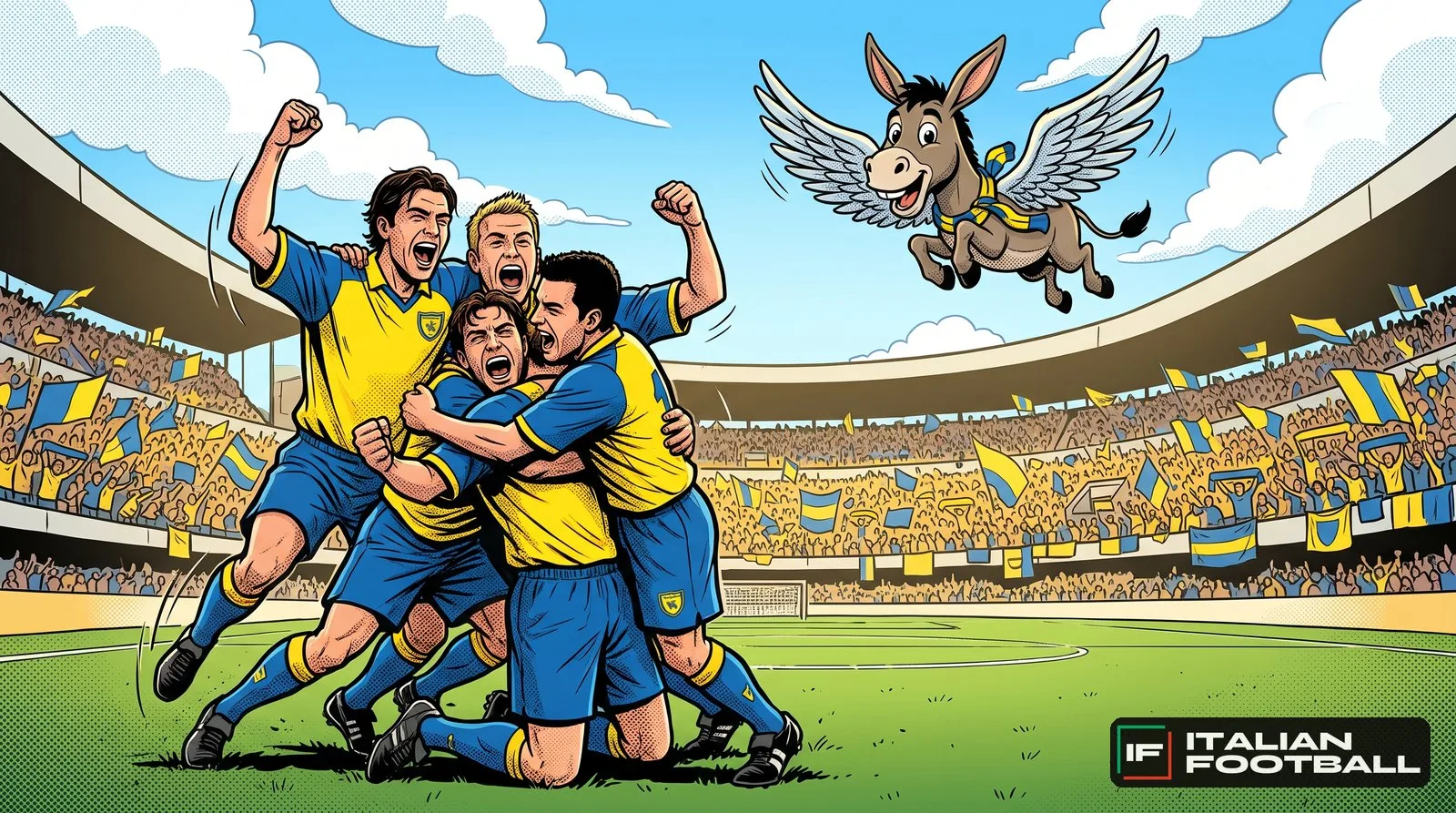
In Verona, there used to be an old joke. Whenever fans of Hellas, the city’s big club, wanted to mock their tiny neighbours from the district of Chievo, they would say: “Chievo will play in Serie A when donkeys fly.” In the summer of 2001, Chievo won promotion to the top flight for the first time in their history. Then, in their very first match, they went to Florence and won 2-0. The donkeys were flying.
What followed was the most heart-warming story of the early 2000s in Italian football, a season when a club from a neighbourhood of a few thousand people stood on top of the best league in the world.
Who were Chievo?
AC Chievo Verona represented a small district on the edge of Verona, and for most of their history they played in the amateur and semi-professional leagues. The club was owned by the Campedelli family, whose Paluani bakery company sponsored the team. Chievo climbed slowly through the divisions in the 1990s, reached Serie B, and in 2000-01, under coach Luigi Delneri, won promotion to Serie A.
Nobody expected them to survive. They had no stars, a tiny fan base and a budget far smaller than that of most of their opponents. Most pundits tipped them for immediate relegation.
How did Chievo start their first Serie A season?
Like a dream. On 26 August 2001, Chievo travelled to Florence and beat Fiorentina 2-0, with goals from Simone Perrotta and Massimo Marazzina. Two weeks later they beat Bologna 2-0 at the Bentegodi, the stadium they shared with Hellas Verona. After two rounds Chievo had six points and had not conceded a goal.
The next match was Juventus away, the Cinderella against the queen. Chievo lost 3-2 in Turin, but they had given the champions a fight, and Italy started to fall in love with them. The Fiorentina side they had beaten on that first day, by the way, was heading for bankruptcy, a story you can read in our piece on Fiorentina from 1998 to 2002.
How did Chievo play under Delneri?
With speed, courage and remarkable organisation. Delneri used a 4-4-2 with two attacking wingers, Eriberto on the right and Christian Manfredini on the left, who pushed high and crossed relentlessly. In the centre, Eugenio Corini directed play and Simone Perrotta, who would win the World Cup with Italy in 2006, provided the energy. Up front, Marazzina and Bernardo Corradi worked tirelessly and scored the goals.
The team pressed high, attacked in numbers and refused to sit back, even against the giants. In a league famous for caution, a newly promoted side playing such brave football was a revelation. Delneri’s system would later be studied and copied by coaches across Italy.
Were Chievo really top of Serie A?
Yes. Chievo sat on top of Serie A for much of the autumn. They lost first place when Milan beat them 3-2 on 2 December 2001, then went to San Siro on 15 December and beat Inter 2-1, one of the title favourites, with goals from Corradi and Marazzina, to climb back to the summit. They finished the first half of the season in third place, an astonishing return for a debutant.
They also played the first ever Serie A derby against Hellas Verona, and won their home fixture 2-1 thanks to two goals from Federico Cossato. For the district of Chievo, beating the big club from the city centre in the top flight was a moment of pure joy.
Where did Chievo finish in 2001-02?
The second half of the season was harder. Opponents started to respect and study them, the small squad grew tired, and Chievo won far fewer games after the winter. But they had built such a strong platform that they still finished fifth, qualifying for the UEFA Cup in their very first Serie A season. Marazzina finished with 13 league goals and Corradi added 10.
It was an achievement on the same level as the great provincial stories of the era, like Vicenza’s 1997 Coppa Italia and Zaccheroni’s Udinese.
What was the Eriberto scandal?
In 2002, it emerged that Chievo’s winger Eriberto was not who he claimed to be. His real name was Luciano Siqueira de Oliveira, and he had played with false documents that also made him younger than he really was. He confessed, served a ban and later returned to play under his real name as Luciano. The episode became one of the strangest footnotes of the era, and it did nothing to dim the affection fans felt for that team.
What happened to Chievo after the miracle?
Chievo stayed in Serie A for most of the next two decades, a remarkable feat for such a small club, and even played in the Champions League preliminary round in 2006 after the Calciopoli scandal reshuffled the table. In 2021, financial problems led to the club’s exclusion from professional football, a sad ending to a wonderful story.
Why do fans still love Chievo’s 2001-02 season?
Because it proved that football can still surprise us. In a league of giants, the Seven Sisters we profile in our series on the golden era of Serie A in the 90s, a team from a neighbourhood with a bakery for a sponsor reached the top. They did it with a clear idea, a brave coach and a group of players who believed. Every underdog story in Italian football since then has been compared to the flying donkeys.
Frequently asked questions
Why are Chievo called the Flying Donkeys?
Hellas Verona fans used to joke that Chievo would reach Serie A “when donkeys fly”. When Chievo were promoted in 2001, they adopted the nickname I Mussi Volanti, the Flying Donkeys.
Were Chievo top of Serie A in 2001-02?
Yes. Chievo won their first two games and led Serie A for much of the autumn, retaking first place after beating Inter at San Siro in December 2001.
Where did Chievo finish in their first Serie A season?
Chievo finished fifth in 2001-02, their first ever Serie A season, and qualified for the UEFA Cup.