| Coach | Alberto Zaccheroni, 1995-1998 |
|---|---|
| Owner | Giampaolo Pozzo |
| Turning point | Juventus 0-3 Udinese, 13 April 1997 |
| 1996-97 | Fifth, first European qualification in club history |
| 1997-98 | Third in Serie A |
| Key players | Bierhoff, Amoroso, Poggi, Helveg, Bertotto, Calori, Turci |
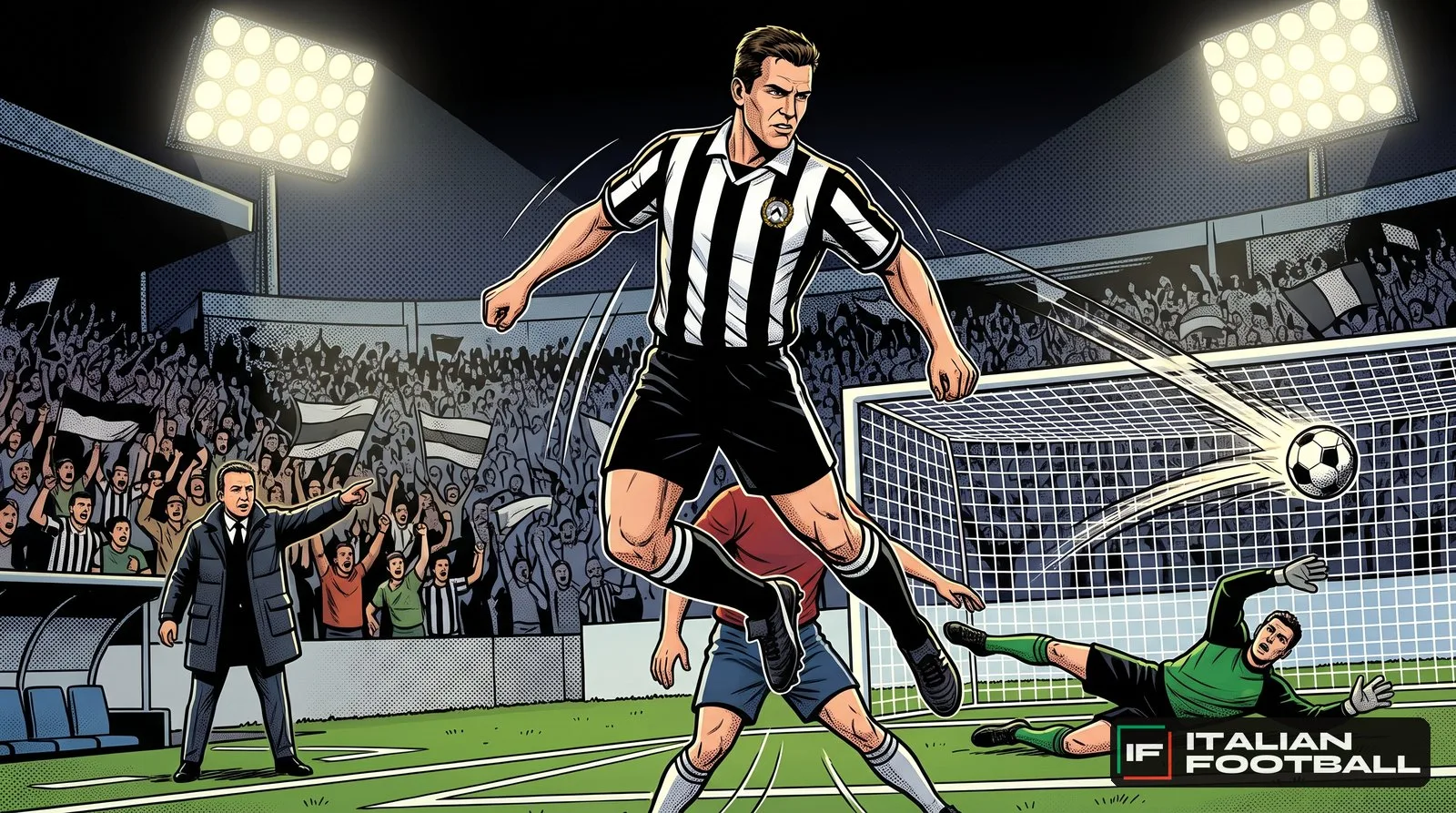
Stadio delle Alpi, 13 April 1997. Juventus are the champions of Europe, on their way to the Scudetto, and Udinese have just lost a defender. Régis Genaux has been sent off after three minutes. Every coach in Italy knows what happens next: take off a forward, bring on a defender, park the bus and pray. Alberto Zaccheroni does the opposite. He keeps all three strikers on the pitch, reorganises the team with three at the back, and tells his players to attack.
Udinese win 3-0. Márcio Amoroso scores twice, Oliver Bierhoff adds the third, and goalkeeper Luigi Turci even saves a penalty from Zinedine Zidane. In one afternoon in Turin, the most influential tactical idea of late-1990s Serie A is born.
Who was Alberto Zaccheroni?
Zaccheroni was a coach from Romagna who had worked his way up through the lower divisions, far from the spotlight, as a coach. He arrived at Udinese in 1995, at a club owned by Giampaolo Pozzo that was known for clever scouting and careful spending rather than trophies. His teams were organised and hard-working, but nobody saw him as a revolutionary.
That changed with the 3-4-3. Zaccheroni had experimented with three-man defences before, but the win in Turin convinced him that the system could work against anyone.
How did Zaccheroni’s 3-4-3 work?
The structure was simple to describe and demanding to execute. Three central defenders, usually Valerio Bertotto, Alessandro Calori and Giovanni Bia or Fabio Pierini, protected the goal. Four midfielders spread across the pitch, with the wide players, like the Danish Thomas Helveg, covering the whole flank. Up front, a powerful centre-forward was flanked by two quick attackers who drifted inside.
The key was width and aggression. The wing-backs and wide forwards stretched opponents, the striker attacked every cross, and the team pressed high. In a league where most sides played a cautious 4-4-2 or a 3-5-2 designed to defend first, Udinese played with three strikers and no fear.
How good were Udinese in 1997-98?
After that win in Turin, Udinese finished fifth in 1996-97 and qualified for European competition for the first time in their history. The following season was even better. Udinese finished third in Serie A, behind Juventus and Ronaldo’s Inter, with one of the most exciting attacks in Europe.
The star was Oliver Bierhoff, the German centre-forward who had won Euro 96 with a golden goal in the final. Bierhoff was brilliant in the air, and Zaccheroni’s system fed him a constant supply of crosses. He scored 27 Serie A goals in 1997-98 and won the Capocannoniere, ahead of Ronaldo. Alongside him, the Brazilian Márcio Amoroso and the local hero Paolo Poggi provided speed and goals.
What happened when Zaccheroni moved to Milan?
The big clubs had been watching. In the summer of 1998, Milan hired Zaccheroni and brought Bierhoff and Helveg with him. Milan had finished tenth the previous season, and few expected a quick turnaround. Zaccheroni installed his 3-4-3, and in 1998-99 Milan chased down Lazio with a remarkable late run of wins to take the Scudetto on the final day. The system born at Udinese had won the title at one of the biggest clubs in the world.
That title race also involved a Fiorentina side that led Serie A at the winter break, a story we tell in our piece on Edmundo and the carnival.
What was it like to watch Zaccheroni’s Udinese?
Exhilarating. Udinese games in those seasons felt like a different sport from the cautious afternoons elsewhere in the league. The ball moved quickly from the back to the wide players, crosses rained into the box, and Bierhoff seemed to win every header. Away from home, where most provincial clubs defended in numbers, Udinese kept three forwards on the pitch and went for the win. Their matches were open, chaotic and impossible to stop watching. For neutral fans across Europe tuning in to Serie A on television, the team in black and white stripes from Friuli became a favourite.
What happened to Udinese after Zaccheroni left?
Udinese kept going. Amoroso stayed and won the Capocannoniere himself in 1998-99, and the club continued to qualify for Europe regularly in the following years, building on Pozzo’s model of buying talented players cheaply and selling them for a profit. That model, which made Udinese one of the most sustainable clubs in Italy, owed a lot to the credibility Zaccheroni’s team had earned.
Why does Zaccheroni’s Udinese matter so much?
Because it showed that a provincial club with a brave idea could change the way the whole league played. Within a few years, three-man defences and wing-backs were everywhere in Serie A, and coaches studied Udinese’s patterns of play. It belongs alongside other great tactical stories of the era, from Capello’s Milan in Athens to Delneri’s Chievo.
It also captures a big part of what made the 1990s so special, which we explore in our series on Serie A in the 90s and 2000s. The league was a laboratory, and sometimes the most important experiments happened far from Milan and Turin. In Udinese’s case, it took a red card after three minutes to start a revolution.
Frequently asked questions
When did Zaccheroni start using the 3-4-3 at Udinese?
Zaccheroni’s 3-4-3 took shape on 13 April 1997, when Udinese kept three forwards after an early red card at Juventus and won 3-0.
How many goals did Bierhoff score for Udinese in 1997-98?
Oliver Bierhoff scored 27 Serie A goals in 1997-98 and won the Capocannoniere, helping Udinese finish third.
Did Zaccheroni win Serie A?
Yes. After leaving Udinese, Zaccheroni won the 1998-99 Scudetto with Milan using the same 3-4-3, with Bierhoff and Helveg in the team.