| Full name | Gabriel Omar Batistuta |
|---|---|
| Nicknames | Batigol, Re Leone (the Lion King) |
| Serie A clubs | Fiorentina 1991-2000, Roma 2000-2003, Inter 2003 |
| Fiorentina goals | 207, the club record |
| Major honours in Italy | Coppa Italia 1996, Supercoppa 1996, Scudetto 2001 (Roma) |
| Capocannoniere | 1994-95, 26 goals |
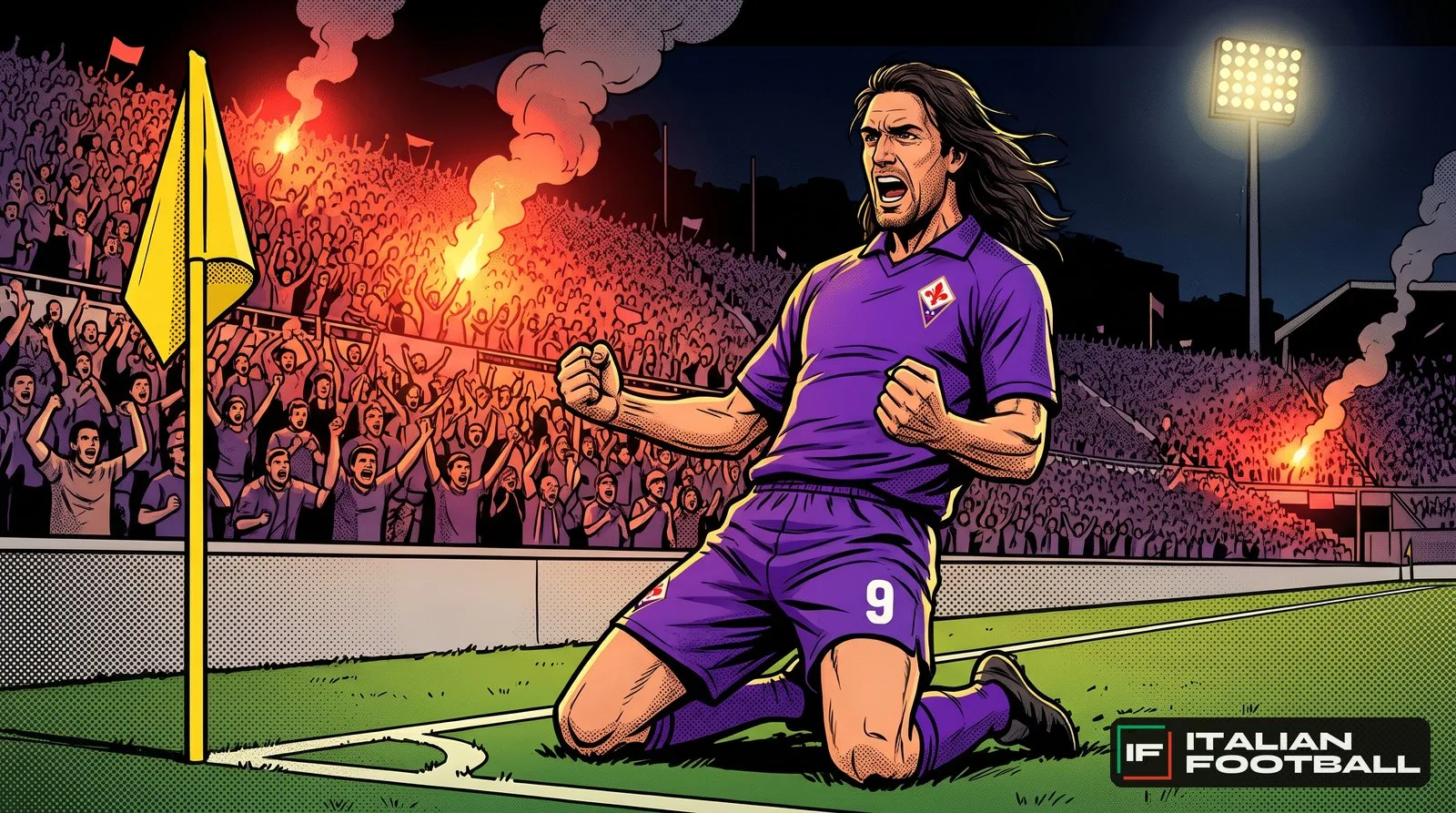
The ball comes in from the right, Batistuta lets it run across his body, and then he hits it. Hard, flat, unstoppable. The net bulges, the Curva Fiesole explodes, and a long-haired Argentine sprints to the corner flag, drops to one knee and fires an imaginary machine gun at the crowd. If you watched Serie A in the 1990s, you saw that scene more times than you can count, and it never got old.
Gabriel Batistuta was the most feared striker in the most defensive league in the world. He was also something rarer: a superstar who chose loyalty when every big club in Europe was calling. That combination is why Florence still treats him like a king.
How did Batistuta end up at Fiorentina?
Fiorentina spotted him at the 1991 Copa América, where he was scoring for fun for Argentina, and signed him from Boca Juniors that summer. He was 22, raw and powerful, and Serie A defenders were not sure what to make of him. He scored 13 league goals in his first season, a solid start in a league where 13 goals was a respectable total for anyone.
The second season turned into a nightmare. Fiorentina were relegated in 1993 despite his 16 league goals, and the natural move for a young international striker was to leave. Batistuta stayed. He spent 1993-94 in Serie B, scored 16 more, and dragged Fiorentina straight back up under Claudio Ranieri. In an era of mercenaries, that decision made him untouchable in the eyes of the Viola fans.
What records did Batistuta set in Serie A?
The most famous came in 1994-95, the first season back in the top flight. Batistuta scored in each of Fiorentina’s first 11 league matches, breaking a Serie A record that had stood since the 1960s. He finished the season as Capocannoniere with 26 goals, at a time when Italian defences were built around men like Paolo Maldini, Alessandro Costacurta and Ciro Ferrara.
He kept going. Season after season he cleared 20 league goals, and by the time he left Florence in 2000 he had scored 207 times for the club in all competitions, more than anyone in Fiorentina’s history. His total of 184 Serie A goals still places him among the best Serie A strikers of all time. Fans built a bronze statue of him in 1996, while he was still wearing the shirt, which tells you how much he meant to them.
Why was Batistuta so hard to stop?
Because he did everything at full power. His shooting was the trademark, a right foot that could beat a goalkeeper from 30 metres with almost no backlift, but he was also brave in the air, strong enough to hold off two centre-backs and quicker than he looked. Defenders in Italy were masters at forcing strikers onto their weaker side or into poor angles. Batistuta simply hit the ball so hard that the angle stopped mattering.
His big European nights showed it best. When Fiorentina returned to the Champions League in 1999-2000, he scored the winner against Arsenal at Wembley and another against Manchester United in Florence. Against the best defences in Europe, the Lion King still found a way.
What did Batistuta win at Fiorentina?
The trophy cabinet never matched the goals, and that is part of the romance. Fiorentina won the Coppa Italia and the Supercoppa Italiana in 1996, with Batistuta at the heart of both. In 1998-99, under Giovanni Trapattoni, they led Serie A at the winter break and looked like genuine Scudetto contenders before an injury to Batistuta and the chaos around his strike partner Edmundo derailed the run. They finished third, and the full story of that season lives in our piece on Fiorentina’s rise and fall.
By 2000, Batistuta was 31 and still without a league title. He knew time was running out, and so did Fiorentina’s president Vittorio Cecchi Gori, whose finances were already wobbling.
Why did Batistuta leave Fiorentina for Roma?
He left to win the Scudetto, and he did it at the first attempt. Roma paid a huge fee for a player past 30, and Fabio Capello built his attack around Batistuta, Francesco Totti and Vincenzo Montella. Batistuta scored 20 league goals in 2000-01 and Roma won their first title in 18 years.
The defining image of that season came on 26 November 2000, when Roma played Fiorentina. Batistuta scored the winning goal with a ferocious volley, and instead of celebrating he stood with his hands over his face, close to tears. Fiorentina’s fans understood. It remains one of the most human moments the league has ever produced.
What is Batistuta’s legacy in Serie A?
He is the benchmark for the classic number 9. Strikers since have been quicker, more technical or more tactically flexible, but few have combined raw power, consistency and loyalty the way Batistuta did. He was also one of the faces of the golden era we explore in our series on Serie A in the 90s and 2000s, a time when a club like Fiorentina could keep a world-class striker for nine years.
His body paid a heavy price for all those goals, and he has spoken openly about the ankle problems that followed him into retirement. In Florence, though, the memory is pure joy. Mention his name in any bar near the Artemio Franchi and someone will drop to one knee and fire the machine gun. Some celebrations last forever.
If you love the strikers of that era, the scoring battles of the same years are just as wild, from Giuseppe Signori at Lazio to Igor Protti’s goals for a relegated Bari.
Frequently asked questions
How many goals did Batistuta score for Fiorentina?
Gabriel Batistuta scored 207 goals for Fiorentina in all competitions between 1991 and 2000, the club’s all-time record.
Did Batistuta ever win Serie A?
Yes. He won the Scudetto with Roma in 2000-01, scoring 20 league goals in his first season at the club.
Why is Batistuta called the Lion King?
Fiorentina fans named him Re Leone, the Lion King, for his long mane of hair, his strength and the fearless way he led the club’s attack.