| Full name | Pavel Nedvěd |
|---|---|
| Nickname | Furia Ceca (the Czech Fury) |
| Italian clubs | Lazio 1996-2001, Juventus 2001-2009 |
| Honours at Lazio | Serie A 2000, Cup Winners’ Cup 1999, UEFA Super Cup 1999, Coppa Italia 1998 and 2000 |
| Honours at Juventus | Serie A 2002 and 2003, Serie B 2007 |
| Individual | Ballon d’Or 2003 |
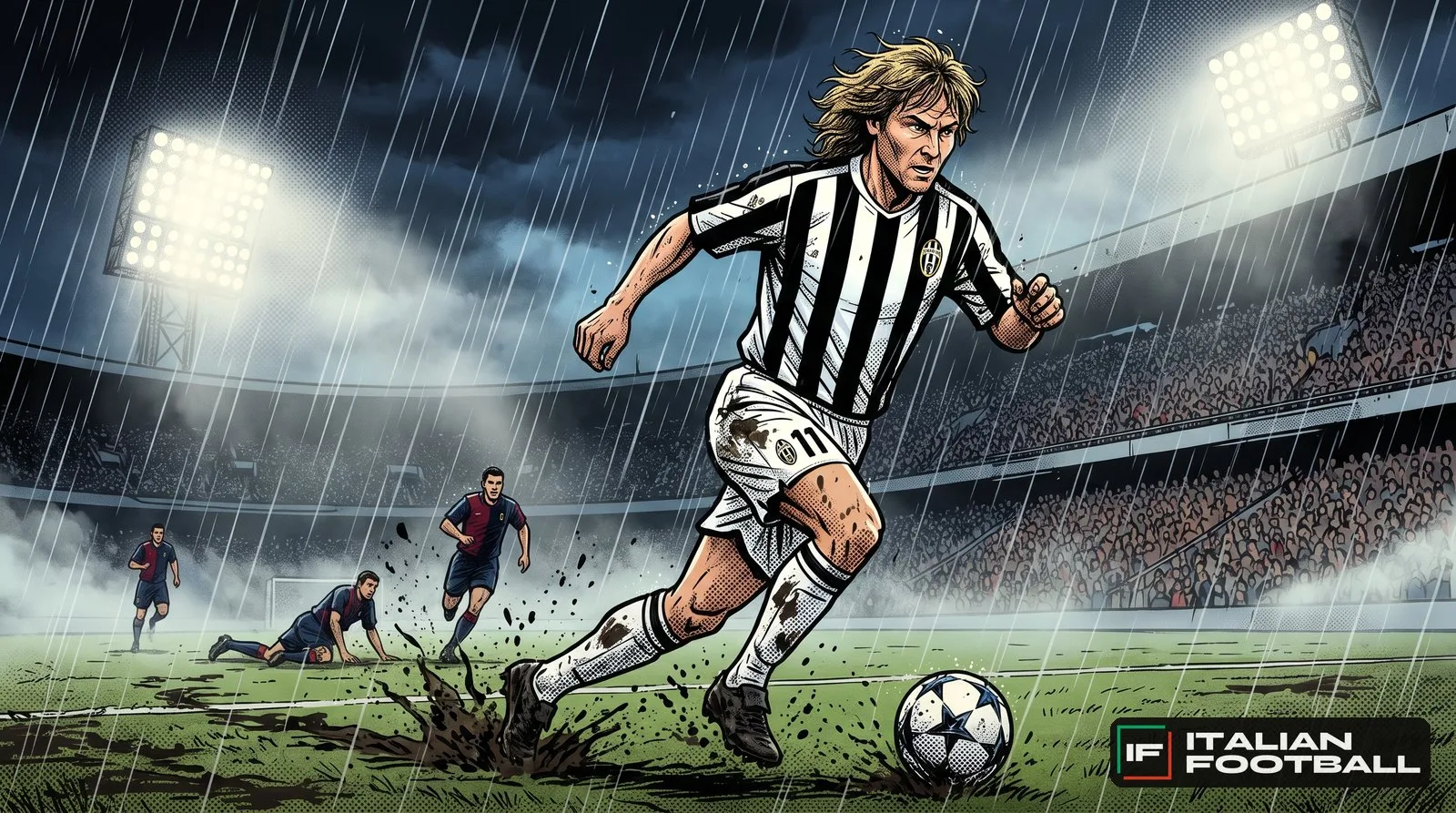
Some players glide. Pavel Nedvěd charged. Blond hair flying, lungs that seemed to have no bottom, he would win the ball in his own box, carry it 60 metres and then smash a shot into the top corner with either foot. By the 90th minute, when everyone else on the pitch was walking, Nedvěd was still sprinting. Italians had a perfect name for him: the Czech Fury.
Across 13 seasons in Italy, Nedvěd became one of the most loved foreign players of his generation, first in Rome and then in Turin. His story has trophies, heartbreak and one of the most admired acts of loyalty the league has ever seen.
How did Nedvěd arrive in Italy?
Euro 96 made his name. The Czech Republic reached the final in England against all expectations, and Nedvěd, then at Sparta Prague, was one of the revelations of the tournament. Lazio moved quickly, and he arrived in Rome that summer, joining a club with big ambitions and an owner, Sergio Cragnotti, ready to spend whatever it took.
He started under Zdeněk Zeman, a fellow Czech whose brutal training methods suited Nedvěd perfectly. When Sven-Göran Eriksson took over in 1997, Nedvěd became a key piece of the team that would challenge for every trophy.
What did Nedvěd win with Lazio?
A lot, and some of it dramatically. Lazio won the Coppa Italia in 1998, and in May 1999 they reached the last ever Cup Winners’ Cup final, against Mallorca at Villa Park in Birmingham. With the score at 1-1, Nedvěd scored the winner, the final goal in the 39-year history of the competition. That August Lazio beat Manchester United to win the UEFA Super Cup.
Then came the big one. In 1999-2000 Lazio chased down Juventus and won the Scudetto on the final day, with Nedvěd at the heart of a midfield that also featured Juan Sebastián Verón, Diego Simeone and Dejan Stanković. They won the Coppa Italia too, completing a historic double. The full drama of that afternoon lives in our story on Lazio’s 2000 Scudetto.
Why did Nedvěd leave Lazio for Juventus?
Money, mostly. Cragnotti’s empire was already under strain, and when Juventus sold Zinedine Zidane to Real Madrid in 2001, they used part of the fee to buy Nedvěd. Lazio fans were furious, and Nedvěd himself was reportedly reluctant to leave Rome. He went anyway, and stepping into Zidane’s shoes was one of the heaviest assignments in football.
He handled it by playing differently. Where Zidane controlled the tempo, Nedvěd attacked from the left, pressed relentlessly and scored spectacular goals from outside the box. Juventus won the Scudetto in 2002 and 2003 under Marcello Lippi, and Nedvěd was the engine of both titles.
Why did Nedvěd miss the 2003 Champions League final?
This is the cruellest moment of his career. In the 2003 semi-final second leg in Turin, Juventus destroyed Real Madrid 3-1 to reach the final. Nedvěd scored a superb goal, but late in the game he chased back and fouled Steve McManaman. The yellow card meant a suspension for the final.
He watched from the stands at Old Trafford as Juventus and Milan drew 0-0, and as Milan won the shootout. Many Juventus fans still believe the result would have been different with Nedvěd on the pitch. As consolation, he won the Ballon d’Or that December, the first Czech winner since Josef Masopust in 1962.
Why did Nedvěd stay at Juventus in Serie B?
In the summer of 2006, the Calciopoli scandal sent Juventus to Serie B and stripped them of two titles. Stars left in a hurry: Fabio Cannavaro, Lilian Thuram, Gianluca Zambrotta, Zlatan Ibrahimović and Patrick Vieira all moved on. Nedvěd, at 33 and with a Ballon d’Or on his shelf, could have gone anywhere.
He stayed. So did Alessandro Del Piero, Gianluigi Buffon, David Trezeguet and Mauro Camoranesi. Juventus won Serie B in 2006-07 and returned to the top flight immediately, and Nedvěd played in the lower division with the same fury he had shown in Champions League semi-finals. For Juventus fans, that decision matters more than any trophy he won.
What is Nedvěd’s legacy in Serie A?
He retired in 2009 and later became a Juventus director and vice-president. On the pitch, he represents a type of player the golden era produced in numbers: technically brilliant, tactically disciplined and physically relentless. You could not survive in Serie A at the turn of the century without all three, which is the story we tell across our series on Serie A in the 90s.
Most of all, he was fun to watch. Every Nedvěd shot felt like it might break the net, and every Nedvěd sprint in the 90th minute made you tired just watching it. Football in those years had characters with very different talents, and our story on Edmundo’s carnival escape from Fiorentina shows just how different the professional standards could be.
Frequently asked questions
When did Pavel Nedvěd win the Ballon d’Or?
Nedvěd won the Ballon d’Or in 2003 as a Juventus player, the first Czech winner since Josef Masopust in 1962.
Why did Nedvěd miss the 2003 Champions League final?
He received a yellow card for a foul on Steve McManaman in the semi-final second leg against Real Madrid, which suspended him for the final against Milan.
Did Nedvěd play in Serie B?
Yes. He stayed with Juventus after the 2006 Calciopoli relegation and helped them win Serie B in 2006-07.